
How Many Calories Should I Eat to Lose Weight? A Simple Guide

The Essentials of Weight Loss Calories
Before you start cutting food, you need to understand the concept of a calorie deficit is the state where you consume fewer calories than your body burns for energy. This is the only way to trigger your body to use stored fat for fuel. If you eat exactly what you burn, you're at maintenance. If you go below that, the scale starts to move. But how much of a deficit is safe? If you drop your calories too low-say, eating only 800 calories a day-your body might freak out. You'll feel exhausted, your hair might thin, and you'll likely crash and binge. A sustainable approach usually means a deficit of 500 to 750 calories per day, which typically leads to a steady loss of about 0.5 to 1 kg (1 to 2 lbs) per week. This pace keeps your metabolism humming and prevents you from losing too much muscle.Quick Summary: How to Find Your Number
- Find your BMR (Basal Metabolic Rate).
- Multiply by your activity level to get your TDEE.
- Subtract 500 calories for steady weight loss.
- Focus on high-protein foods to protect muscle.
- Stay hydrated and monitor your energy levels.
Calculating Your Personal Baseline
To know how much to eat, you first need to know your BMR (Basal Metabolic Rate). BMR is the number of calories your body burns just to keep your heart beating and lungs breathing while you're lying perfectly still in bed. It's the absolute minimum energy your organs need to function. Once you have your BMR, you apply an activity multiplier to find your TDEE (Total Daily Energy Expenditure). TDEE represents the total amount of energy you burn in a 24-hour period, including exercise and general movement.| Activity Level | Description | Multiplier |
|---|---|---|
| Sedentary | Office job, little to no exercise | BMR x 1.2 |
| Lightly Active | Light exercise 1-3 days/week | BMR x 1.375 |
| Moderately Active | Moderate exercise 3-5 days/week | BMR x 1.55 |
| Very Active | Hard exercise 6-7 days/week | BMR x 1.725 |
The Role of Macronutrients
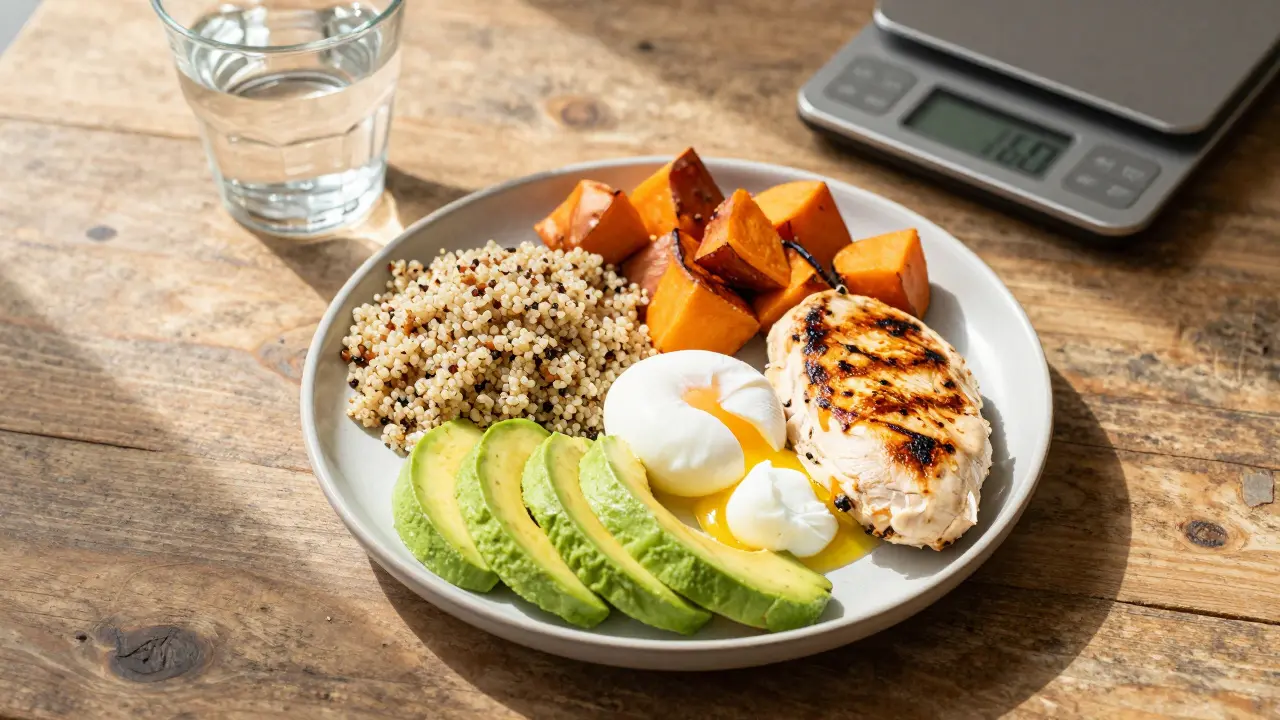
Counting calories tells you *how much* to eat, but macronutrients tell you *what* to eat. You can eat 1,600 calories of donuts or 1,600 calories of steak, eggs, and vegetables. While both might lead to weight loss, the donut version will leave you starving and tired, while the protein-heavy version will keep you full and preserve your muscle mass. Protein is the most critical macro for weight loss. It has a high thermic effect, meaning your body burns more calories digesting it than it does for fats or carbs. Aim for roughly 1.6 to 2.2 grams of protein per kilogram of body weight. This stops your body from eating its own muscle tissue during a deficit. Carbohydrates provide the energy for your workouts. Instead of cutting them completely, focus on complex carbs like oats, quinoa, and sweet potatoes. These prevent the blood sugar spikes and crashes that lead to intense cravings. Fats are essential for hormone production; don't drop them too low, or you'll start feeling moody and fatigued.Managing Cravings and Liquid Calories
One of the biggest traps in a weight loss journey is the "invisible calorie." These are calories we drink without realizing it. A large latte or a full-sugar soda can easily add 300 to 500 calories to your day, which could completely wipe out your deficit. This is where switching to low-calorie energy drinks or water can be a game-changer. If you rely on caffeine for a mid-afternoon boost, choosing a sugar-free version instead of a traditional energy drink can save you hundreds of calories. For someone on a tight budget of 1,600 calories, saving 200 calories on a drink means you can have a larger, more satisfying dinner. However, be mindful of artificial sweeteners. While they don't add calories, some people find they trigger hunger or cravings. The goal is to find a balance that keeps your energy high without spiking your insulin levels.
Common Pitfalls to Avoid
Why do so many people fail even when they think they're eating the right amount? Usually, it's due to tracking errors. Most people underestimate how many calories they eat by about 20% to 30%. A tablespoon of olive oil is 120 calories; a "handful" of nuts can be 200. If you aren't weighing your food with a digital scale, you're guessing. Another mistake is the "weekend blowout." If you maintain a 500-calorie deficit from Monday to Friday, you've created a 2,500-calorie gap. If you then eat an extra 3,000 calories over Saturday and Sunday through pizza and cocktails, you've actually ended the week in a surplus. Consistency is more important than perfection for one or two days. Lastly, avoid the temptation to keep dropping calories as you plateau. When your weight stops moving, it's often because your body has adapted. Instead of eating less, try increasing your NEAT (Non-Exercise Activity Thermogenesis). This is the energy spent on things like pacing while on the phone, cleaning the house, or taking the stairs. Increasing your daily step count from 5,000 to 10,000 is often more sustainable than cutting another 200 calories from your plate.Adjusting Your Plan Over Time
Your calorie needs are not static. As you lose weight, you become a smaller person, which means your body requires less energy to move and maintain itself. A calorie target that worked when you weighed 90kg will not work when you weigh 80kg. Every 5kg lost, or every 4 to 6 weeks, recalculate your TDEE. If you've hit a plateau for more than two weeks, you have two choices: either slightly decrease your intake (by about 100 calories) or increase your physical activity. Many people find that a "maintenance break"-eating at their TDEE for a week-helps reset their hormones and mental state before diving back into a deficit.Can I lose weight if I eat more than 2,000 calories?
Yes. If you are very active, tall, or have a lot of muscle mass, your TDEE might be 3,000 calories. In that case, eating 2,500 calories still puts you in a 500-calorie deficit, which will lead to weight loss.
Is it okay to eat below my BMR?
Generally, no. Eating below your BMR for long periods can lead to muscle loss, metabolic slowdown, and nutrient deficiencies. It's better to keep calories above BMR and increase activity to create the deficit.
Do low-calorie energy drinks stall weight loss?
Not directly. Weight loss is driven by total calories. However, some people find that artificial sweeteners increase their appetite. If you feel hungrier after drinking them, try switching to black coffee or green tea.
How long does it take to see results?
Most people see a drop in water weight within the first week. Real fat loss usually becomes apparent in the mirror and on the scale after 3 to 4 weeks of consistent calorie tracking.
Should I track calories every single day?
For beginners, daily tracking helps build awareness of portion sizes. Once you're experienced and know what a 400-calorie meal looks like, you can switch to "intuitive eating" or tracking only a few days a week.