
Is 1200 Calories a Day Too Much to Lose Weight?
When someone says they’re eating just 1200 calories a day to lose weight, they’re usually trying to do the right thing. Cut calories, burn more, lose pounds. Simple, right? But here’s the truth: 1200 calories a day isn’t about whether it’s too much-it’s about whether it’s too little for your body to function safely.
Why 1200 Calories Feels Like a Good Idea
Most weight loss advice tells you to create a calorie deficit. If you burn 2000 calories a day and eat 1200, that’s an 800-calorie gap. Sounds like fast results. And yes, you’ll probably lose weight quickly at first. But weight loss isn’t just about numbers on a scale. It’s about hormones, muscle, energy, and long-term health.People often pick 1200 calories because it’s the number they see on diet apps, fitness blogs, or even doctor’s notes. It’s become a default. But that number wasn’t designed for you. It was designed for a 5-foot-tall, 120-pound woman who’s sedentary. If you’re taller, more active, or male, 1200 calories is likely far below what your body needs.
Your Body Isn’t a Calculator
Your body doesn’t respond to starvation like a math equation. When you drop below a certain calorie threshold-usually between 1200 and 1500 for most adults-your metabolism starts to slow down. It’s called adaptive thermogenesis. Your body thinks it’s in famine mode. It holds onto fat. It breaks down muscle for energy. Your thyroid works slower. Your leptin levels drop. That’s the hormone that tells your brain you’re full. When it falls, you feel hungrier, more tired, and more obsessed with food.A 2019 study in the journal Obesity followed 50 people on a 1200-calorie diet for 12 weeks. The average weight loss was 11 pounds. But 68% of them regained the weight within a year. Why? Because their metabolism didn’t bounce back. It got stuck.
Who Should Avoid 1200 Calories a Day
If you’re under 5’5” and weigh less than 120 pounds, maybe 1200 is okay for a short time. But if you’re:- Over 5’5” tall
- Over 130 pounds
- Active (walking 8,000+ steps a day, lifting weights, or exercising regularly)
- Female and menstruating
- Over 30 years old
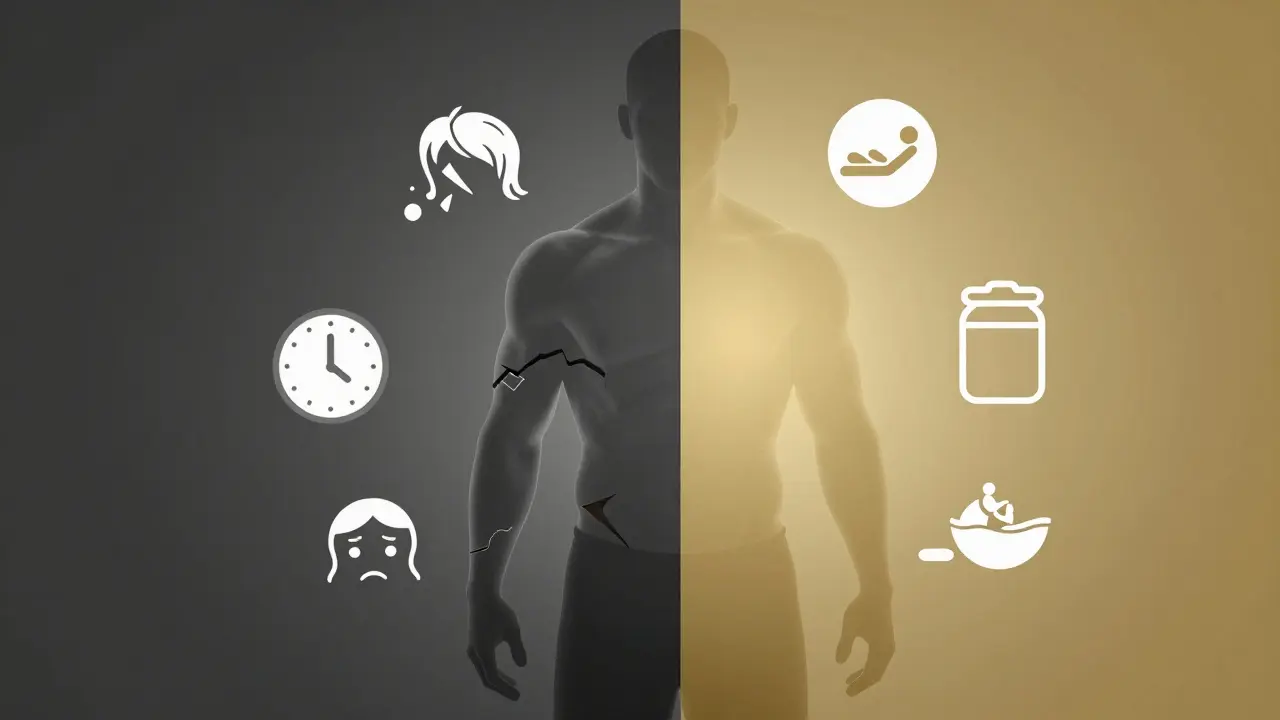
Then 1200 calories is probably too low. Your body needs fuel to repair tissue, regulate hormones, and keep your immune system working. Cutting too hard can lead to hair loss, missed periods, constant coldness, brain fog, and even heart rhythm problems.
What Happens When You Eat Too Few Calories
You might think you’re losing fat. But what you’re really losing is:- Muscle mass (your body uses protein for energy when calories are too low)
- Water weight (temporary, bounces back)
- Metabolic rate (slows down permanently in some cases)
- Energy (you’ll feel drained, irritable, unable to focus)
And here’s the kicker: the more you restrict, the harder it becomes to stick to it. Hunger isn’t just physical-it’s psychological. Studies show people on very low-calorie diets are more likely to binge later. That’s not failure. That’s biology.
What’s the Right Calorie Range?
There’s no magic number. But here’s a simple way to find yours:- Calculate your maintenance calories. Use a free online TDEE calculator (Total Daily Energy Expenditure). Input your height, weight, age, and activity level.
- Subtract 300-500 calories. That’s your sweet spot for steady, sustainable fat loss.
- Don’t go below 1400 for women or 1600 for men unless under medical supervision.
For example:
- A 5’7”, 160-pound woman who walks 7,000 steps daily: maintenance is ~2000 calories. Aim for 1500-1700.
- A 6’0”, 190-pound man who lifts weights 4x a week: maintenance is ~2700. Aim for 2200-2400.
That’s still a deficit. But it’s one your body can handle without shutting down.
Food Quality Matters More Than Quantity
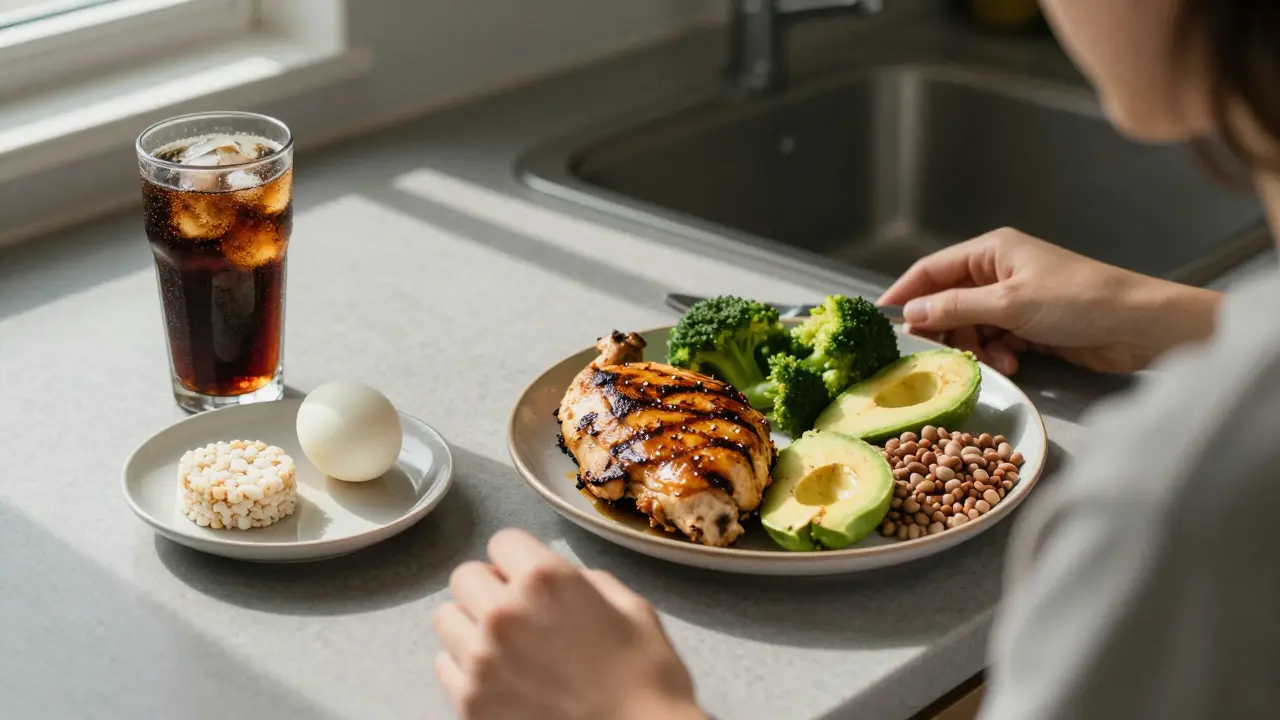
Eating 1200 calories of sugary cereal, diet soda, and protein bars is very different from eating 1200 calories of chicken, broccoli, eggs, oats, and avocado. The first leaves you hungry, nutrient-deficient, and craving more. The second keeps you full, energized, and satisfied.Protein should be 0.8-1 gram per pound of body weight. Fiber should be at least 25g a day. Healthy fats (nuts, olive oil, fish) help regulate hunger hormones. Skip these, and even 1200 calories won’t feel enough.
What About Low-Calorie Energy Drinks?
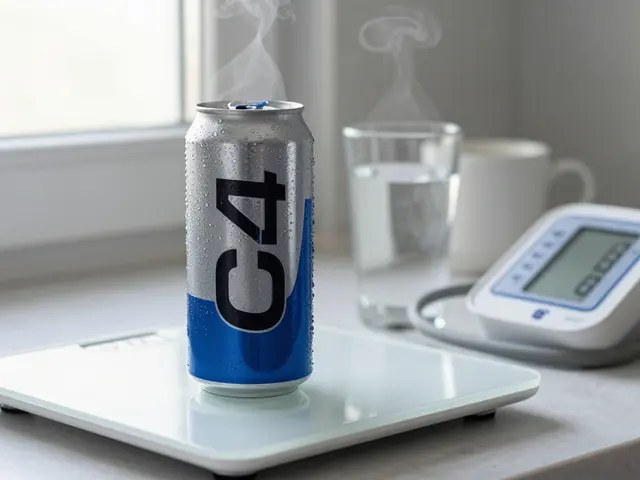
You might be tempted to drink low-calorie energy drinks to “save calories” while staying alert. But here’s the problem: they’re not magic. A 10-calorie energy drink doesn’t give you energy-it gives you caffeine and artificial sweeteners. That might mask fatigue, but it doesn’t fix it. And if you’re already eating too few calories, caffeine can make you feel jittery, anxious, or even cause heart palpitations.Instead of reaching for a sugar-free energy drink, try:
- Drinking water with lemon
- Getting 7-8 hours of sleep
- Taking a 10-minute walk
- Eating a small protein-rich snack (like Greek yogurt or hard-boiled eggs)
These actually restore energy. Energy drinks just trick your body into thinking it’s awake.

Long-Term Weight Loss Isn’t About Restriction
The people who keep weight off don’t eat 1200 calories forever. They eat enough to feel good. They move because they enjoy it. They sleep. They manage stress. They don’t count every calorie-they focus on habits.Weight loss that lasts isn’t about how little you eat. It’s about how well you take care of yourself.
What to Do Instead
If you’re currently eating 1200 calories and feeling exhausted:- Slowly add 100-200 calories a day for a week. Use whole foods: an extra egg, a handful of almonds, half a banana.
- Track how you feel-energy, sleep, hunger, mood.
- Once you feel better, recalculate your TDEE and aim for a 300-500 calorie deficit from there.
- Focus on protein, fiber, and sleep. Not the scale.
Your body isn’t broken. It’s just trying to survive. Give it the fuel it needs, and it’ll respond.
Is 1200 calories a day safe for weight loss?
For most adults, 1200 calories a day is too low and can lead to muscle loss, hormonal disruption, and metabolic slowdown. Women should generally not go below 1400 calories, and men below 1600, unless under medical supervision. It may cause fatigue, hair loss, and missed periods. Sustainable weight loss comes from a moderate deficit, not extreme restriction.
Why am I not losing weight on 1200 calories a day?
Your body may have slowed its metabolism in response to low calorie intake. This is called adaptive thermogenesis. You might also be underestimating your calorie intake or overestimating your activity level. Stress, poor sleep, or hormonal imbalances (like thyroid issues) can also block weight loss-even with a low-calorie diet.
Can I eat 1200 calories if I’m very active?
No. If you’re active-exercising regularly, walking a lot, or doing strength training-you need more fuel. Eating only 1200 calories while being active puts your body in a catabolic state, where it breaks down muscle for energy. This reduces metabolism and makes fat loss harder over time. Active people need at least 1500-1800 calories, depending on size and activity level.
Do low-calorie energy drinks help with weight loss?
No. Low-calorie energy drinks don’t help with weight loss. They contain caffeine and artificial sweeteners that may temporarily boost alertness but don’t provide real energy or reduce hunger. Relying on them while eating too few calories can increase anxiety, disrupt sleep, and lead to cravings. Better alternatives include water, sleep, movement, and protein-rich snacks.
How many calories should I eat to lose weight safely?
Aim for a deficit of 300-500 calories below your maintenance level. For most women, that’s 1500-1700 calories. For most men, it’s 1900-2200. Use a TDEE calculator to find your baseline. Prioritize protein, fiber, and whole foods. Slow, steady weight loss (0.5-1 pound per week) is more sustainable and healthier than rapid loss.
Final Thought
You don’t need to starve to lose weight. You need to nourish yourself enough to thrive. The goal isn’t to hit 1200 calories. It’s to build a life where you feel strong, energized, and in control-without counting every bite.


Comments (12)
Donald Sullivan
17 Mar 2026
1200 calories? Bro, that’s not a diet, that’s a death wish wrapped in a MyFitnessPal screenshot. You think you’re being ‘disciplined’? Nah. You’re just training your body to hoard fat like a squirrel on caffeine. I’ve seen guys hit 1200 and end up crying over a peanut butter packet. Your metabolism doesn’t care about your Instagram progress pics. It cares about survival. Stop punishing yourself and start feeding yourself like an adult.
Tina van Schelt
18 Mar 2026
1200 calories is like trying to run a Ferrari on a teaspoon of gas. You’re not ‘losing weight’-you’re just slowly dismantling your engine piece by piece. Hair falling out? Brain fog? Craving carbs like they’re your ex’s texts? That’s not ‘willpower.’ That’s your body screaming for a rescue mission. Give it real food-eggs, avocado, salmon, greens-and watch how your energy, mood, and even your reflection start to glow. You’re not a calorie counter. You’re a human being. Treat yourself like one.
Ronak Khandelwal
19 Mar 2026
💖 I see you, sweet soul, trying so hard to be ‘good’-but let me whisper something gentle: your worth isn’t measured in calories. 🌱 Your body isn’t a math problem. It’s a sacred temple that’s been told it’s ‘too much’ for too long. When you eat 1200, you’re not healing-you’re surviving. And honey, survival isn’t the goal. Thriving is. Try adding one handful of almonds today. Just one. Then breathe. Then notice how your body says ‘thank you.’ You’re not broken. You’re blooming. 🌸
Jeff Napier
20 Mar 2026
1200 calories is fine if you're not a slave to the system. The FDA and big pharma want you fat so they can sell you drugs. They made 1200 seem dangerous so you'd keep buying their supplements. I ate 800 for 6 months and lost 40lbs. My thyroid? Fine. My energy? Better. They're lying to you. They want you dependent. Wake up.
Sibusiso Ernest Masilela
21 Mar 2026
Oh, here we go. Another ‘nutritionist’ with a TED Talk voice and a LinkedIn profile. 1200 calories? Please. You’re speaking to people who’ve never seen a real gym or a whole food. If you’re eating 1200 and not losing, you’re either a lazy excuse-maker or you’re still eating donuts and calling them ‘protein bowls.’ Real men eat 2000 and lift. Real women don’t whine about ‘hormones’-they train hard and eat steak. Stop infantilizing yourself.
Daniel Kennedy
22 Mar 2026
Look-I get it. You saw 1200 on a blog and thought ‘this is the answer.’ But here’s the truth: you’re not failing because you’re weak. You’re failing because you were given a one-size-fits-none plan. I’ve coached hundreds. The ones who stuck? They stopped counting. They started listening. They ate until they were satisfied-not stuffed, not starving. Protein first. Veggies always. Fats without guilt. Then, they moved because it felt good, not because they owed it to a scale. You don’t need to be perfect. You just need to be consistent. And kind. To yourself.
Taylor Hayes
23 Mar 2026
Reading this made me think of my sister. She did 1200 for 8 months. Lost 20 lbs. Then gained back 30. Not because she ‘slacked’-because her body went into panic mode. She started eating 1600. No tracking. Just eggs, chicken, greens, nuts. Within 3 weeks, her energy came back. Her sleep improved. Her cravings vanished. She didn’t ‘give up’-she finally started nourishing herself. You don’t have to starve to heal. You just have to stop fighting your body. It’s not your enemy. It’s your ally. Just… give it a chance to breathe.
Sanjay Mittal
25 Mar 2026
For Indians, 1200 calories is especially dangerous. Traditional diets are carb-heavy. Cutting to 1200 means you’re eating mostly rice and lentils without enough protein or fat. Result? Blood sugar crashes, fatigue, bingeing on samosas at night. I recommend at least 1800 for men, 1600 for women. Add ghee, paneer, nuts, eggs. Not just ‘calories’-nutrients. Your body remembers hunger. Don’t let it forget how to thrive.
Mike Zhong
25 Mar 2026
What if the entire concept of ‘calorie deficit’ is a capitalist lie? What if weight loss isn’t about energy balance, but about insulin sensitivity, circadian rhythm, and ancestral biology? We’ve been sold a reductionist model because it’s easy to monetize. The real issue isn’t 1200 vs 1600-it’s that we’ve disconnected from food as ritual, as culture, as communion. You don’t fix a broken system by tweaking numbers. You rebuild the system. But who’s going to fund that TED Talk?
Jamie Roman
26 Mar 2026
I want to say something real. I was the person eating 1200 calories for 14 months. I thought I was being disciplined. I was just terrified. Terrified of being ‘too much.’ Terrified of being seen. The weight came off, sure-but I lost my joy. I stopped laughing. I cried over a slice of toast. Then I started eating 1800. Not to lose weight. Just to feel human again. And guess what? My body didn’t explode. It didn’t binge. It just… settled. It started trusting me. And slowly, the weight began to leave-not because I chased it, but because I stopped fighting myself. If you’re reading this and you’re tired-I see you. Eat the damn avocado. You deserve to feel full.
Salomi Cummingham
27 Mar 2026
Oh. My. GOD. I read this and I just sobbed into my oat milk latte. 🥲 I was 19, 5’2”, 110 lbs, and I thought 1200 calories was ‘healthy.’ I lost my period. My hair fell out in clumps. I wore sweaters in July because I was always cold. I thought I was ‘strong.’ I was just broken. I didn’t heal until I ate a whole grilled salmon with butter on it. And then I cried because it tasted like love. You’re not weak for needing more. You’re brave for finally asking for it. Please. Please. Eat the food. You’re worth more than a number.
Johnathan Rhyne
28 Mar 2026
Correction: It’s not ‘1400 for women’-it’s 1400 for sedentary women under 120 lbs. You’re misquoting the data. Also, ‘TDEE calculator’? Those are garbage. They use regression models based on 1980s data. Real energy expenditure? Measured via doubly labeled water. And guess what? Most people overestimate their activity by 30-50%. So if you’re eating 1500 and not losing, you’re probably already at maintenance. Also, ‘protein bars’? Those are sugar-coated bricks. Use real food. And stop using ‘hormones’ as an excuse. It’s not PCOS. It’s just bad math.