
Are Energy Drinks Okay If You Workout?

When you're pushing hard in the gym or racing through a trail run, energy drinks look like the quick fix you need. They promise a burst of energy, sharper focus, and even better endurance. But are they actually helping-or hurting-your workout? The answer isn’t simple. It depends on what’s in the drink, when you drink it, and how your body reacts.
What’s really in energy drinks?
Most energy drinks contain three main ingredients that affect your workout: caffeine, sugar, and electrolytes. A typical 250ml can has about 80mg of caffeine-similar to a strong cup of coffee. Some brands pack over 200mg. That’s more than the FDA recommends in a single sitting for adults.
Sugar? That’s another story. Many popular energy drinks have 27g of sugar per can-that’s nearly 7 teaspoons. A 2023 study from the University of Queensland found that athletes who drank sugary energy drinks before endurance training saw a short-term performance boost, but also had higher blood sugar spikes and slower recovery afterward. If you’re working out to lose fat or manage insulin sensitivity, that sugar can undo a lot of your effort.
Then there are electrolytes. Sodium, potassium, magnesium-these help with fluid balance and muscle function. But most energy drinks have just enough to taste good, not enough to truly replace what you lose through sweat. You’d need to drink 3-4 cans to match what’s in a proper sports drink. And that means way too much caffeine and sugar.
When energy drinks might help
There are real cases where energy drinks can be useful. If you’re doing a high-intensity session-think HIIT, CrossFit, or a competitive race-and you haven’t had time to eat, a small amount of caffeine can sharpen focus and delay fatigue. A 2024 meta-analysis in the Journal of Sports Sciences showed that 3-6mg of caffeine per kg of body weight improved time-to-exhaustion by an average of 12% in trained athletes.
That’s about 200-300mg for a 70kg person. So if you’re drinking a can with 160mg caffeine and you’re already used to coffee, it might give you that edge. Timing matters too. Drink it 30-45 minutes before your workout. That’s when caffeine peaks in your bloodstream.
Some athletes also use energy drinks during long events-like marathons or triathlons-when they need quick calories and stimulation. But even then, they often choose versions with less sugar and added electrolytes, not the soda-like brands you see in convenience stores.

The hidden downsides
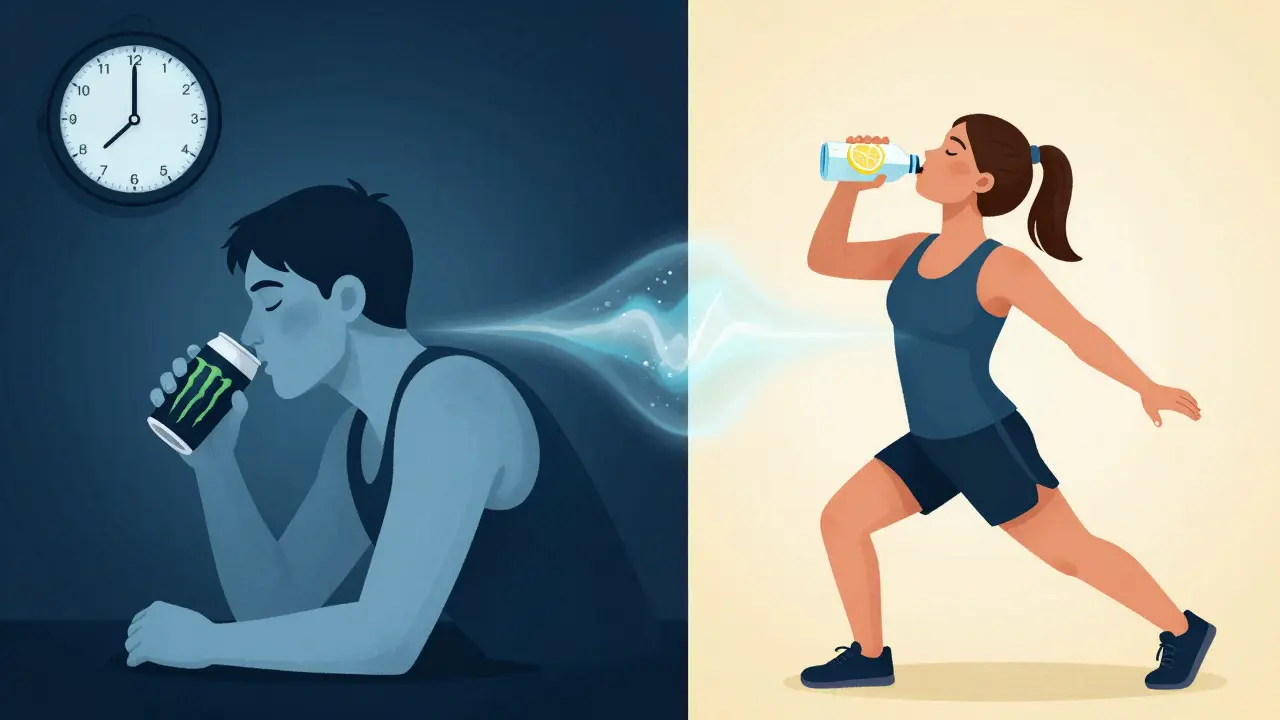
Here’s what most people don’t think about: energy drinks don’t replace water. They can actually make dehydration worse. Caffeine is a mild diuretic, which means it increases urine production. If you’re sweating hard and chugging a sugary, caffeinated drink, you’re not hydrating-you’re adding stress to your system.
And then there’s the crash. That sugar rush? It doesn’t last. Within 60-90 minutes, blood sugar drops, leaving you more tired than before. For endurance athletes, this can mean hitting a wall mid-run or losing focus during the final stretch.
Long-term use has also been linked to higher resting heart rates and increased blood pressure. A 2025 study from Monash University followed 1,200 regular gym-goers who drank energy drinks 3+ times a week. After 12 months, 37% showed elevated resting heart rates-enough to raise concerns about cardiovascular strain, especially in younger athletes.
And don’t forget the calories. One can of energy drink = 110-150 empty calories. If you’re drinking one daily, that’s over 1,000 extra calories a week. That’s a pound of fat every 3-4 weeks-without even changing your diet.
What should you drink instead?
For most workouts under 90 minutes, plain water is still the best choice. Add a pinch of salt and a squeeze of lemon if you’re sweating a lot. It’s cheap, natural, and doesn’t spike your blood sugar.
If you need more, try:
- Black coffee-no sugar, no additives. About 150mg caffeine per 12oz cup. You control the dose.
- Electrolyte tablets or powders-dissolve in water. Brands like Nuun or LMNT give you sodium, potassium, and magnesium without sugar or caffeine.
- Low-sugar sports drinks-look for under 10g of sugar per 250ml. Some, like Gatorade Zero or Powerade Zero, use artificial sweeteners. They’re better than the sugary versions, but not perfect.
- Coconut water-natural electrolytes, moderate sugar. Good for light to moderate workouts.
For long or intense sessions, consider making your own drink: water + a pinch of salt + a splash of orange juice + a teaspoon of honey. It’s real food, not science lab in a can.
Who should avoid energy drinks completely?
Some people should skip them entirely:
- Anyone under 18-your body is still developing, and caffeine can interfere with sleep, brain development, and heart rhythm.
- People with anxiety, high blood pressure, or heart conditions-caffeine can trigger palpitations or panic attacks.
- Those who struggle with sleep-if you drink energy drinks after 2pm, you’re likely sabotaging your recovery.
- People training for endurance events-relying on sugar-heavy drinks trains your body to burn sugar, not fat. That limits your stamina long-term.
Bottom line: Use them smart, not often
Energy drinks aren’t evil. But they’re not magic. If you’re using them as a daily crutch to get through workouts, you’re missing the point. Real energy comes from sleep, hydration, and balanced meals-not a brightly colored can.
Use energy drinks like a tool, not a habit. Save them for race day, a tough training session, or when you’re truly running on empty. And always check the label: look for under 100mg caffeine, under 10g sugar, and real electrolytes. Anything else? Stick to water.
Can energy drinks improve my workout performance?
Yes, but only in specific cases. Caffeine at doses of 3-6mg per kg of body weight can improve focus, delay fatigue, and boost power output in short, intense workouts. However, the sugar and artificial additives in most energy drinks can hurt recovery and hydration. For most people, black coffee or electrolyte water works better without the downsides.
Are sugar-free energy drinks better for workouts?
They’re better than sugary versions, but not necessarily good. Sugar-free drinks cut out the calorie spike, but many still contain high caffeine (over 200mg) and artificial sweeteners like aspartame or sucralose. Some studies suggest these sweeteners may alter gut bacteria and insulin response over time. For workouts, plain water with added electrolytes is still the cleanest option.
Is it safe to drink energy drinks before cardio?
It depends. If you’re doing light to moderate cardio like jogging or cycling, caffeine can help you push harder. But if you’re doing long endurance cardio, the diuretic effect of caffeine can lead to dehydration. Plus, the crash afterward can leave you drained. For steady-state cardio, water with electrolytes is safer and more sustainable.
Do energy drinks help with muscle recovery?
No. Energy drinks don’t contain the protein, branched-chain amino acids, or anti-inflammatory compounds needed for muscle repair. In fact, the high sugar and caffeine content can increase inflammation and delay recovery. For recovery, focus on protein, hydration, and sleep-not energy drinks.
How long does caffeine from energy drinks last during a workout?
Caffeine peaks in your bloodstream about 30-60 minutes after drinking it. Its effects can last 3-5 hours, but the performance boost usually fades after 90-120 minutes. That’s why timing matters: drink it 45 minutes before your workout to sync the peak with your training session.

Comments (12)
deepak srinivasa
22 Mar 2026
Been drinking energy drinks for years before lifting. Thought they were magic. Turned out they just made me crash harder. Now I stick to black coffee and a banana. No more 3pm collapse in the gym.
Simple. Works.
pk Pk
23 Mar 2026
Really glad someone laid this out so clearly. I used to chug these before every workout like it was a ritual. Then I started noticing my heart racing at night, couldn’t sleep, and my recovery sucked. Switched to water + pinch of salt + lemon. Changed everything. Your body doesn’t need sugar bombs to sweat.
It just needs consistency. And sleep. And water. Not a can.
NIKHIL TRIPATHI
25 Mar 2026
For me, it’s all about timing. If I’m doing a 2-hour trail run, I’ll take a sugar-free electrolyte drink mid-way. But before? Nope. Black coffee 45 minutes prior, then water every 20 minutes. The crash after a sugary drink is brutal - like your body hits a wall and says ‘nope, not today.’
Also, the artificial sweeteners? I’ve read studies where they mess with your gut microbiome over time. Not worth it for a temporary buzz.
And honestly? You don’t need to ‘fuel’ a 60-minute lift with a can of Red Bull. Protein and carbs post-workout matter way more than pre-workout hype.
Shivani Vaidya
26 Mar 2026
The scientific evidence presented here is compelling and aligns with current physiological understanding of hydration and metabolic response during physical exertion. The emphasis on electrolyte balance and the avoidance of excessive sugar intake is particularly noteworthy. It is regrettable that marketing often obscures the biological reality of these products. A return to simplicity - water, salt, and natural sources of stimulation - represents not merely a preference but a physiological imperative.
Rubina Jadhav
28 Mar 2026
I used to drink them before yoga. That was dumb. Now I just drink water. Much better.
sumraa hussain
29 Mar 2026
Bro. I did a 10K last weekend and chugged a Monster halfway. Felt like a superhero… then hit the wall so hard I walked the last mile. My legs felt like wet noodles. My brain? Gone. Like someone pulled the plug.
And then I saw my reflection in a store window - pale, sweating, eyes wide like I’d seen a ghost. I swear I heard my heart go ‘thump-thump-thump-thump’ like a drum solo.
That’s not energy. That’s your body screaming for mercy.
Now I carry a water bottle. And a banana. And peace. I’m a better runner. And a calmer human.
Raji viji
31 Mar 2026
Oh wow, another ‘drink water’ lecture. Real groundbreaking. You think people don’t know caffeine’s a diuretic? Newsflash - I don’t drink energy drinks to hydrate. I drink them to not die during my 5am HIIT session. You’re telling me to sip lemon water while sprinting up a hill? That’s not fitness, that’s a spa day.
And sugar? Yeah, it spikes. So what? I’m not trying to be a vegan monk. I need fuel. Real fuel. Not some hippie tea with a side of self-righteousness.
Also, your ‘black coffee’ suggestion? That’s fine if you’re a 30-year-old with zero stress and a 9-to-5. Try working three jobs, sleeping 4 hours, and still making it to the gym. Then talk to me about ‘clean’ options.
And don’t even get me started on ‘electrolyte tablets.’ Who the hell carries those? I’m not hiking Mount Everest. I’m trying not to pass out on the treadmill.
Rajashree Iyer
2 Apr 2026
There is a metaphysical truth here - energy drinks are not merely substances, they are modern-day talismans. We clutch them like amulets against the void of exhaustion, believing in their glow, their fizz, their promise of transcendence.
But what are we really chasing? Not performance. Not strength. Not endurance.
We are chasing the illusion that we can outpace time.
And in that chase, we forget: true energy is not manufactured. It is cultivated. In silence. In rest. In the quiet breath between effort and surrender.
One can sprint on sugar. But only the soul can endure.
Parth Haz
2 Apr 2026
While the article provides a comprehensive overview, I would like to emphasize the importance of individual variability. Metabolic responses to caffeine and sugar differ significantly based on genetics, training status, and circadian rhythm. What may be detrimental for one individual may be performance-enhancing for another. A blanket recommendation to avoid energy drinks may overlook the nuanced needs of competitive athletes.
That said, the emphasis on hydration and whole-food alternatives remains valid for the general population. A balanced, personalized approach is ideal.
Vishal Bharadwaj
2 Apr 2026
lol at the ‘3-4 weeks for a pound of fat’ thing. You think people care? Most of us are just trying to get through the day. Also, ‘under 100mg caffeine’? That’s like saying ‘don’t drink coffee’ - because who even makes a drink with 80mg anymore? And electrolytes? You think a can of Gatorade has enough? Nah. You need like 3-4 of those to even match sweat loss. So now you’re drinking 3 cans? So now you’re at 600mg caffeine. So now you’re at 80g sugar. So now you’re at 300 calories. So now you’re at a heart attack. So now you’re dead. So now you’re a statistic.
Meanwhile, I’m just trying to finish my set.
And you’re over here writing a thesis.
Welp. I’ll keep my Monster. And my dignity.
anoushka singh
2 Apr 2026
Wait so you’re saying I shouldn’t drink an energy drink before my 8pm workout? But I’m already tired from work… what else am I supposed to do? Cry into my protein shake? 😅
Jitendra Singh
2 Apr 2026
My coach told me to stop drinking them. I didn’t believe him. Then I started having weird palpitations during cool-down. Scared me straight. Now I use electrolyte powder in water. No crash. No jitters. Just steady effort. Took me 6 months to break the habit. But now? I feel like I’m finally training - not just surviving it.