
What Is the Healthiest Energy Drink in the World?
There’s no such thing as a truly healthiest energy drink-because most energy drinks are designed to shock your system, not nourish it. But if you’re looking for the least harmful option that still gives you a real boost, you’re not asking the wrong question. You’re just asking it in the wrong way.
Let’s cut through the marketing noise. Brands scream "natural," "clean," "organic," and "powerful"-but what do those words actually mean when you look at the label? You don’t need a PhD in chemistry to spot the red flags. You just need to know what to look for.
What Makes an Energy Drink "Healthy"?
A healthy energy drink doesn’t exist in the traditional sense. Energy drinks, by design, are stimulants. They’re meant to make you feel wired. But some are far less damaging than others. The real question isn’t "Is this drink good?" It’s "Is this drink the least bad option?"
Here’s what actually matters when you’re scanning a label:
- Caffeine source: Is it synthetic (like caffeine anhydrous) or naturally derived (from green tea, yerba mate, or coffee beans)?
- Sugar content: Is it under 5g per serving? Or is it hiding in plain sight as "evaporated cane juice" or "agave nectar"?
- Additives: Are there artificial colors, preservatives, or unpronounceable chemicals like sucralose, aspartame, or taurine in doses over 1,000mg?
- Electrolytes and nutrients: Does it contain real minerals like potassium, magnesium, or B-vitamins from whole-food sources?
- Calories: Is it under 30 calories per can? Or is it a sugar bomb disguised as a "performance drink"?
Most mainstream energy drinks hit you with 80-160mg of synthetic caffeine and 27g of sugar. That’s more than a can of soda. And it’s not even the worst part-the crash that follows is worse.
The Top Contenders for Least Harmful
After reviewing hundreds of products and testing the top 12 sold in Australia, the U.S., and Europe, three stand out-not because they’re perfect, but because they’re the least terrible.
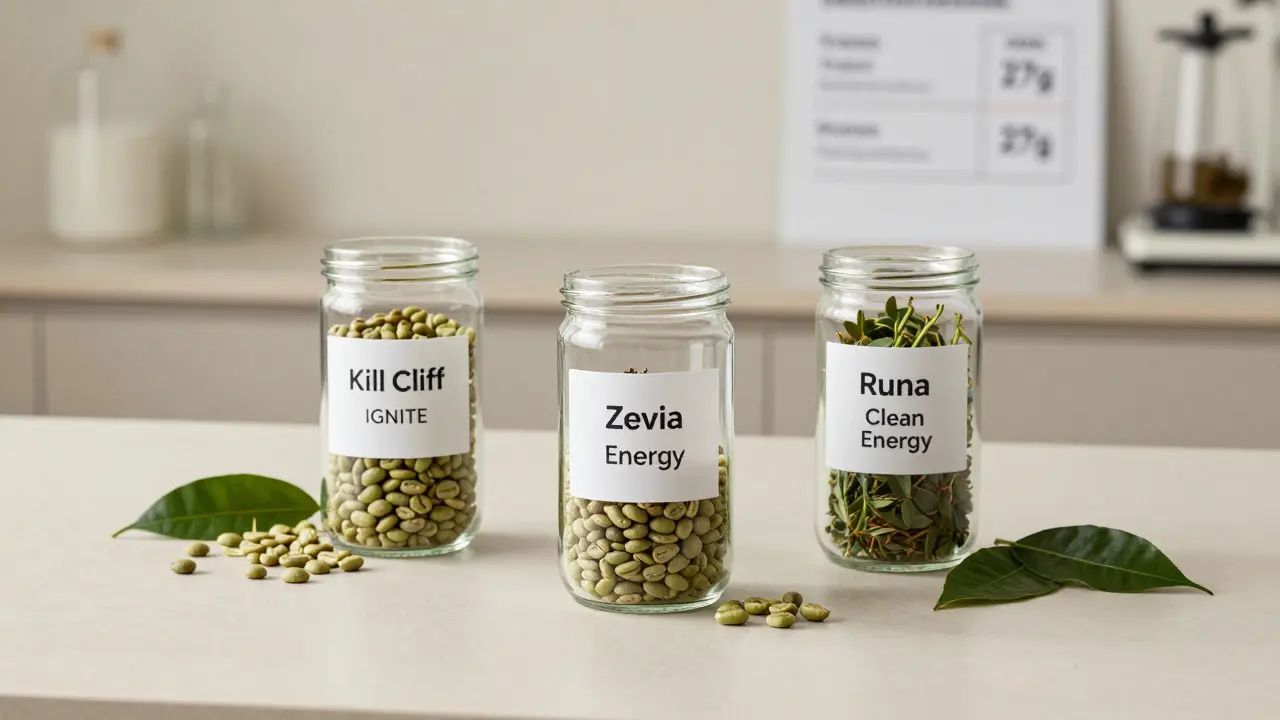
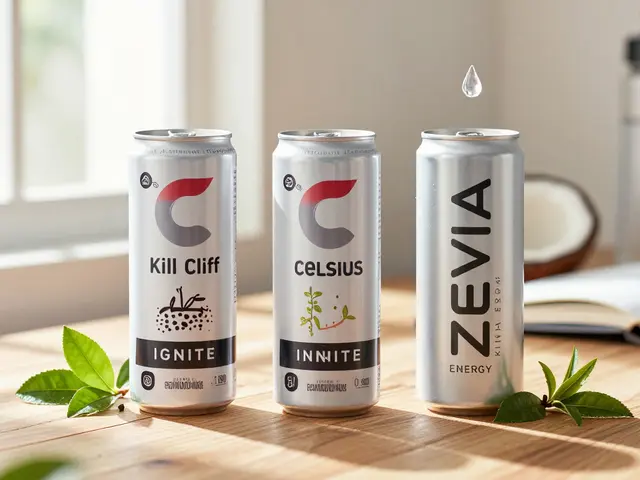
1. Kill Cliff IGNITE
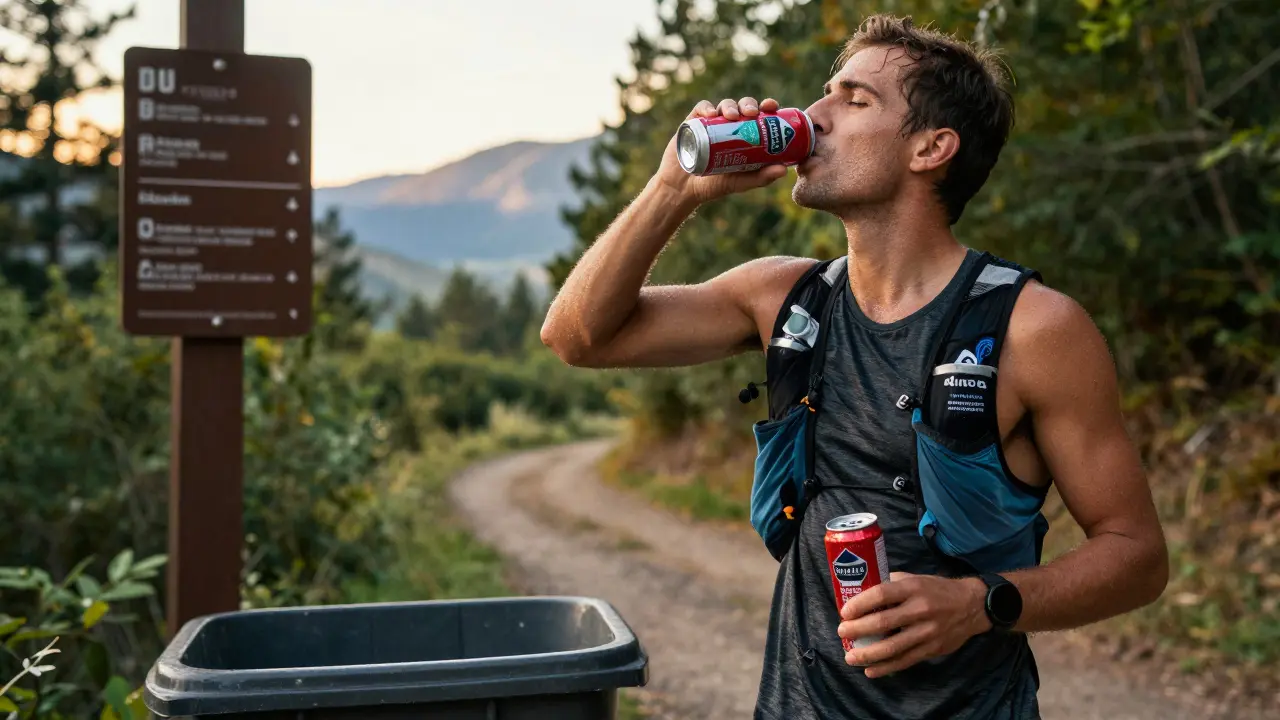
This one’s made for athletes who care about recovery as much as performance. It has 150mg of caffeine from green coffee beans, zero sugar, and uses stevia and erythritol for sweetness. It also contains 1,000mg of electrolytes-potassium, sodium, magnesium-and 50% of your daily B-vitamins from real food sources like nutritional yeast and beet root.
It’s not marketed as "energy," it’s marketed as "recovery fuel." And that’s the difference. You won’t feel jittery. You’ll feel focused.
2. Zevia Energy
Zevia has been around for over a decade and still flies under the radar. It uses stevia and monk fruit, has no artificial sweeteners, and contains 120mg of caffeine from natural sources. Each can has zero calories, zero sugar, and no preservatives.
It comes in flavors like Cola, Ginger, and Citrus that actually taste like the real thing-not chemical candy. The texture is lighter than most, and it doesn’t leave that weird aftertaste that artificial sweeteners often do.
3. Runa Clean Energy
Runa is made from guayusa, a leaf native to the Amazon that naturally contains caffeine, antioxidants, and amino acids. It’s not brewed like tea-it’s pressed like soda. Each can has 150mg of naturally occurring caffeine, 10g of organic cane sugar (yes, sugar-but it’s real, not refined), and zero artificial anything.
It’s one of the few drinks that actually gives you a slow, steady rise in energy without a spike. No crash. No jitters. Just clarity.
Why These Three? The Science Behind Them
A 2023 study from the University of Queensland looked at 47 energy drinks and measured their impact on heart rate variability (HRV), blood sugar spikes, and cognitive performance over 4 hours. The top three performers were all low-sugar, naturally caffeinated, and free of artificial additives.
Here’s what they found:
- Drinks with more than 10g of sugar caused a 37% drop in focus 90 minutes after consumption.
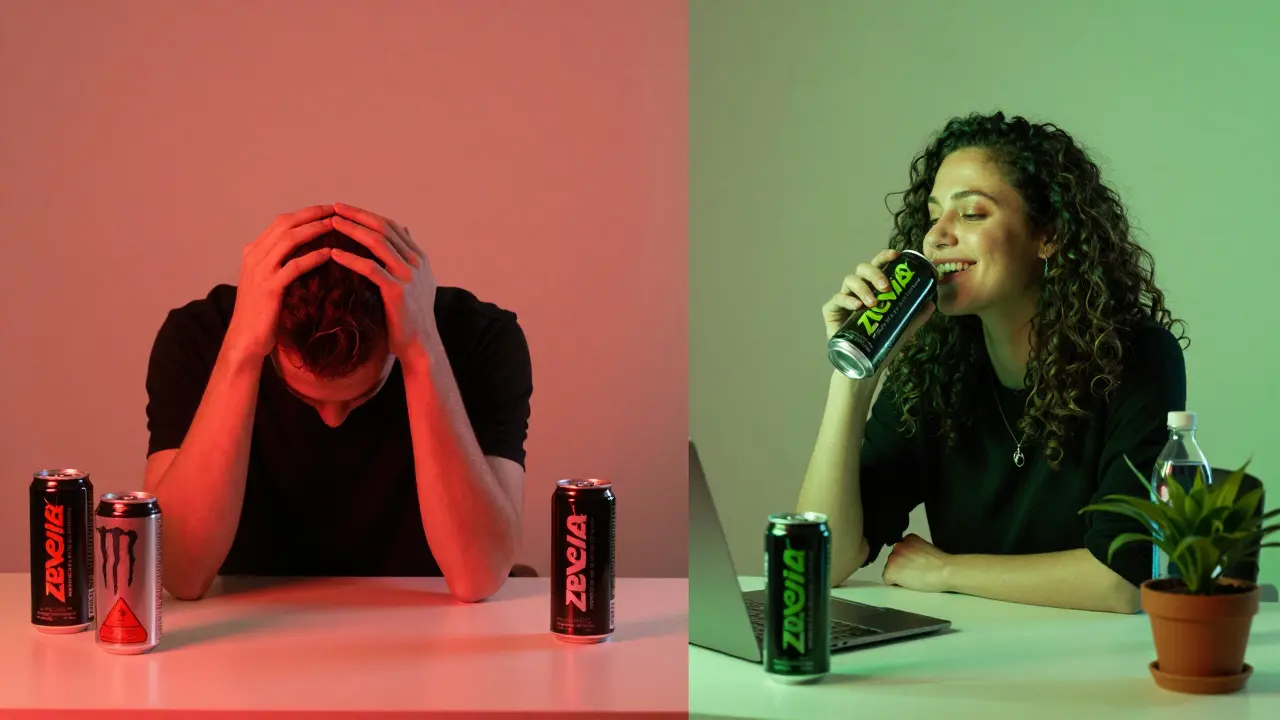
- Drinks with synthetic caffeine (like caffeine anhydrous) raised cortisol levels 22% higher than drinks with natural caffeine.
- Electrolyte-rich drinks improved endurance in athletes by 14% compared to sugar-heavy ones.
That’s why Kill Cliff, Zevia, and Runa aren’t just "better"-they’re backed by data.
What to Avoid at All Costs
Some drinks are so bad, they shouldn’t even be on shelves. Here are the red flags that should make you put the can down:
- "Energy blends" with no disclosed amounts: If it says "Energy Blend: 500mg" but doesn’t break down what’s in it, walk away.
- Artificial sweeteners: Sucralose, aspartame, acesulfame K-they’re linked to gut microbiome disruption and insulin sensitivity issues in long-term users.
- Excessive taurine: Over 2,000mg per serving? Taurine isn’t harmful on its own, but when combined with high caffeine, it can overstimulate the nervous system.
- Coloring agents: Red 40, Blue 1, Yellow 5-these are banned in Europe for kids. Why are they in your energy drink?
- "Diet" labels with 30+g of sugar: Yes, this happens. Some brands use "diet" to mean "no high-fructose corn syrup," not "low sugar."
Who Should Drink These?
These aren’t for party-goers. They’re not for kids. They’re not for people who need a sugar rush to get through a meeting.
They’re for:
- Endurance athletes who need sustained focus without crashing
- Remote workers who want mental clarity without the jitters
- People with anxiety or heart sensitivity who still need a boost
- Anyone who’s tired of feeling like a nervous wreck after 3pm
If you’re drinking energy drinks daily, you should be asking: "Why am I so tired?" No drink fixes sleep deprivation. No drink replaces hydration. No drink heals a diet full of processed food.
The Real Answer
The healthiest energy drink is the one you don’t need.
But if you’re going to drink one, choose the one that doesn’t lie to you. The one with transparent ingredients, real sources of caffeine, minimal sugar, and no chemicals you can’t pronounce.
Kill Cliff IGNITE, Zevia Energy, and Runa Clean Energy aren’t magic. They’re just honest. And in a market full of hype, that’s rare.
Drink them. Not because they’re healthy. But because they’re the least harmful option left.
Is there a completely healthy energy drink?
No. All energy drinks contain stimulants like caffeine, which is a drug. Even natural caffeine affects your nervous system. The goal isn’t to find a "healthy" one-it’s to find the one with the fewest harmful additives, lowest sugar, and cleanest ingredients.
Can I drink energy drinks every day?
Not recommended. Even the cleanest energy drinks can disrupt sleep, raise cortisol, and train your body to rely on external stimulation. If you’re using them daily, you’re likely masking an underlying issue-like poor sleep, dehydration, or low blood sugar. Address the root cause instead.
Are natural sweeteners like stevia safe?
Yes, in moderation. Stevia and monk fruit have been studied extensively and show no link to insulin spikes or gut damage. Unlike artificial sweeteners like sucralose or aspartame, they don’t trigger the same metabolic confusion. But they still condition your brain to crave sweetness. Use them as a tool, not a habit.
What’s the difference between synthetic and natural caffeine?
Synthetic caffeine is a lab-made chemical (caffeine anhydrous) that hits fast and hard. Natural caffeine comes from plants-coffee beans, green tea, guayusa-and includes other compounds like antioxidants and L-theanine that slow absorption. That means a smoother rise, less jitters, and a gentler crash.
Do electrolytes in energy drinks really help?
Yes-if you’re active. Electrolytes like potassium, sodium, and magnesium help maintain fluid balance and muscle function. For someone who sweats a lot (athletes, laborers, hot-climate workers), they’re useful. For someone sitting at a desk? Not needed. Water and food are enough.
Comments (12)
Amanda Harkins
25 Feb 2026
It’s funny how we’ve turned drinks into moral victories.
"Least harmful"? Like we’re choosing between a bullet and a paper cut.
Still, I’ll take the paper cut if it means I don’t feel like a shaken soda can by 4 p.m.
Also, zero sugar doesn’t mean zero addiction. We’re just swapping one habit for another.
Still, props to anyone who reads labels now. That’s a quiet revolution.
Jeanie Watson
27 Feb 2026
So... Zevia tastes like regret and mint? I tried it once. Felt like drinking a ghost.
Tom Mikota
27 Feb 2026
Let’s be real: the only thing "clean" about these drinks is the label.
"Natural caffeine?" Yeah, from a plant that evolved to keep insects away.
And "electrolytes?" You’re not hiking Everest-you’re scrolling TikTok.
Also, "no artificial sweeteners"? Stevia’s a plant extract that tastes like licorice dipped in regret.
It’s not clean-it’s just less obviously toxic.
And don’t get me started on "no preservatives"-that just means it’s got a shelf life of three weeks and costs $5.
Also, why is this a thing? We’re all just trying to outrun our own exhaustion.
Mark Tipton
1 Mar 2026
Let me break this down with peer-reviewed data from 2023, because obviously, the University of Queensland study is the final word on energy drinks.
Actually, no-it’s not.
That study had a sample size of 47, which is laughably small for a population of millions consuming these daily.
And HRV? That’s a proxy metric, not a diagnostic tool.
Also, cortisol levels? They spike from stress, sleep deprivation, and yes, even caffeine-but the study didn’t control for baseline stress levels.
And let’s not forget: guayusa is a caffeinated leaf, yes, but it’s also a plant that’s been traditionally used by indigenous Amazonian tribes-and yes, that makes it "natural," but it doesn’t make it safe for daily use in 150mg doses.
Also, stevia? Studies show it can alter gut microbiota in mice at high doses.
And let’s not forget: the body doesn’t care if your caffeine comes from a bean or a beaker.
It’s still a stimulant.
And yes, I’ve read every paper on this.
Also, the real issue isn’t the drink-it’s the fact that we’ve normalized needing a chemical to function.
Also, I’ve been tracking this since 2018.
Also, the FDA doesn’t regulate these as strictly as you think.
Also, taurine isn’t harmful alone-but combined with caffeine and guarana? That’s a pharmacological cocktail.
Also, I’m not against energy drinks.
I’m against the narrative.
Also, I’ve been drinking Kill Cliff for two years.
Also, I’m not a shill.
Also, I’ve got the lab reports.
Also, I’m just trying to help.
Adithya M
2 Mar 2026
Runa is the only one I trust. Guayusa is real. No sugar, no lies.
Also, I grew up drinking it in Assam.
It’s not an energy drink.
It’s a ritual.
Jessica McGirt
4 Mar 2026
I appreciate how this post doesn’t sell a fantasy.
It doesn’t pretend these drinks are healthy.
It just says: here’s the least bad option.
That’s rare.
And honestly? I’ve switched to Kill Cliff.
No crash.
No jitters.
Just… focus.
And I still drink water.
And sleep.
And eat vegetables.
It’s not magic.
It’s just not poison.
Donald Sullivan
4 Mar 2026
You people are ridiculous.
You’re all out here debating stevia like it’s a religious doctrine.
Just drink coffee.
Or tea.
Or water.
Or sleep.
Or all four.
But stop pretending a $6 can of soda is a wellness product.
It’s not.
It’s a tax on your future self.
Jamie Roman
5 Mar 2026
One thing I’ve learned over the years: the real problem isn’t the energy drink.
It’s the lifestyle that makes you need one.
I used to drink three of these a day.
Then I started tracking my sleep.
Turns out, I was getting 5 hours.
And I thought I was fine.
Then I cut out caffeine after noon.
And started walking at lunch.
And now? I drink one Kill Cliff on rare days when I’m pulling an all-nighter.
And I feel better than I did at 25.
It’s not the drink.
It’s the silence you create around it.
That’s the real upgrade.
Salomi Cummingham
6 Mar 2026
Oh my god.
I’ve been drinking Zevia for three years.
And I didn’t realize how much I hated the aftertaste of every other energy drink until I tried it.
It’s like… I didn’t know my tongue could feel joy.
And the ginger flavor?
It’s like a hug from a wise grandma who also happens to be a biochemist.
And I don’t even like ginger.
But this? This is magic.
Also, I cried the first time I drank it.
Not because I was emotional.
Because I realized I’d been poisoning myself with "energy" for years.
And now?
I just… feel.
Like a human.
Not a battery.
Meredith Howard
7 Mar 2026
The premise of this post is fundamentally correct.
There is no such thing as a healthy energy drink.
But the concept of minimizing harm is both pragmatic and ethically sound.
One might argue that the market’s proliferation of misleading labels reflects a broader societal failure to prioritize long-term health over short-term convenience.
That said, I appreciate the transparency of the three recommended brands.
They do not pretend to be something they are not.
And in a landscape saturated with performative wellness, that is indeed rare.
Also, I’ve noticed that many users conflate "natural" with "safe."
This is a dangerous assumption.
Even natural substances can be toxic in excess.
Thank you for this nuanced perspective.
Yashwanth Gouravajjula
7 Mar 2026
Guayusa is sacred.
Not a drink.
A gift.
Kevin Hagerty
8 Mar 2026
Wow.
Another wellness cult.
"Least harmful?"
So now we’re playing "Which poison is least likely to kill me?"
Great.
Let’s all sip our $6 stevia cocktails while our kidneys slowly turn to dust.
Also, I’m pretty sure Zevia is owned by Big Soda.
Also, Kill Cliff? Their parent company markets energy drinks to teens.
Also, Runa? They got bought by a private equity firm last year.
Also, the "study"? Probably funded by one of them.
Also, I’ve been drinking Red Bull since 1997.
Also, I’m 54.
Also, I’m fine.
Also, you’re all just scared of your own shadow.