
Why Is Mountain Dew Banned in Europe?
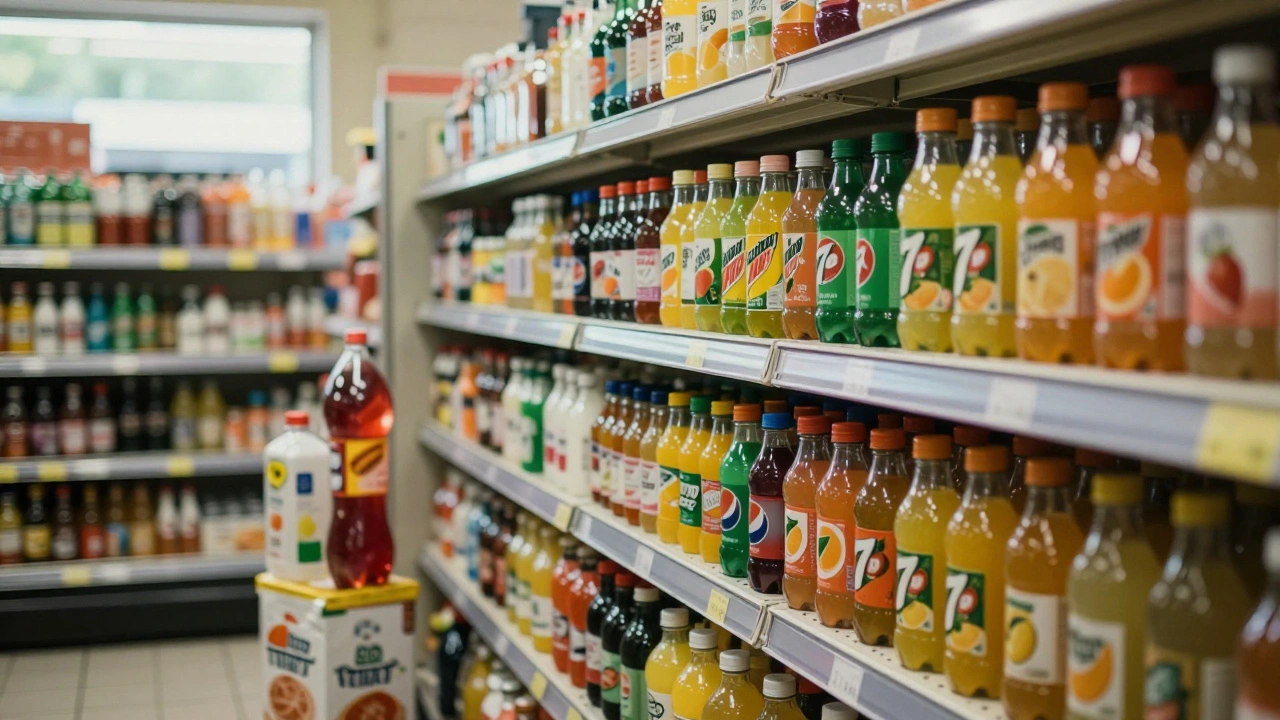
Mountain Dew isn’t officially banned in Europe-but it’s not sold there either. And the reason isn’t some conspiracy or secret government order. It’s because one of its ingredients, brominated vegetable oil (BVO), is forbidden in the European Union and many other countries. If you’ve ever wondered why you can’t find a cold bottle of Mountain Dew at a grocery store in Germany or France, the answer lies in a chemical that’s been under scrutiny for decades.
What Is Brominated Vegetable Oil (BVO)?
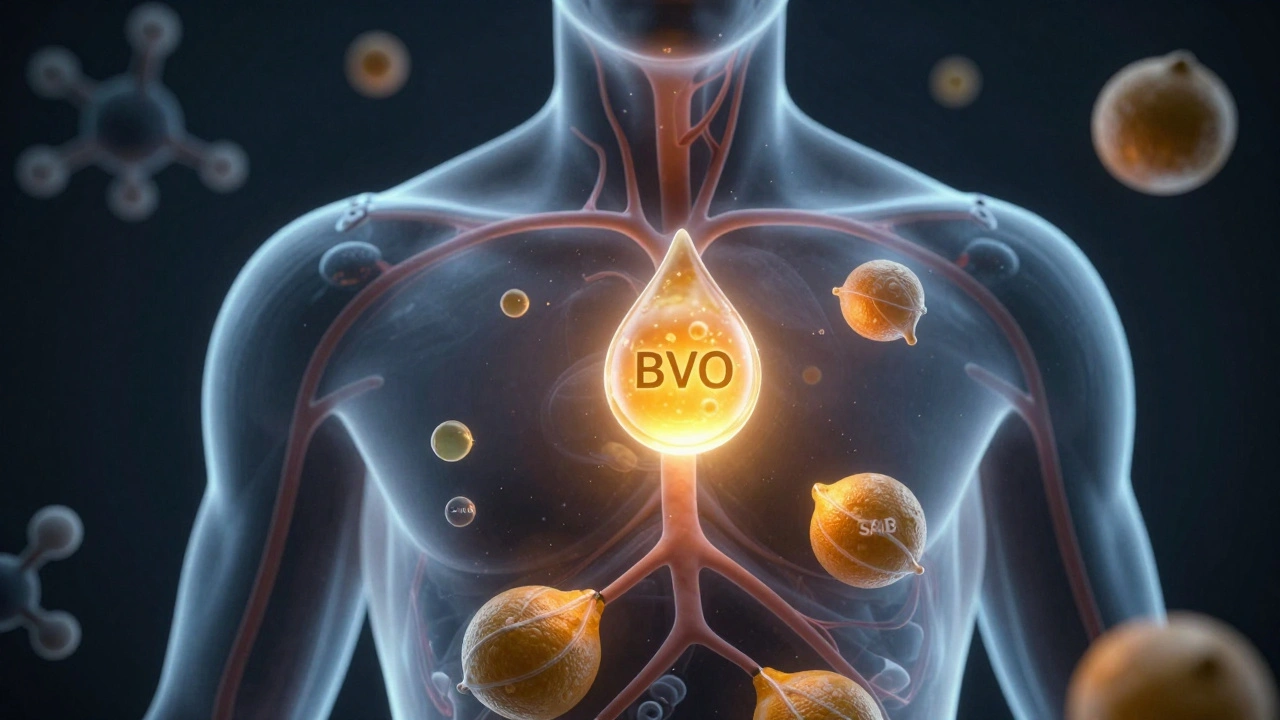
BVO is a synthetic chemical made by bonding vegetable oil with bromine. It was originally developed in the 1920s to help citrus-flavored drinks stay mixed. Without BVO, the flavor oils in sodas like Mountain Dew would float to the top, leaving you with a watery drink and a greasy ring on the bottle. BVO acts like a glue, keeping those oils suspended evenly.
But bromine is a halogen element-same group as chlorine and iodine-and when it’s bonded to plant oils, it creates a compound that the human body doesn’t handle well. In high doses, bromine can build up in tissues, interfere with thyroid function, and even affect nerve signaling. That’s why countries like the EU, Japan, and Canada don’t allow it in food or drinks.
Why Does the U.S. Still Allow It?
The U.S. Food and Drug Administration (FDA) classifies BVO as an “interim food additive,” meaning it’s allowed under strict limits-no more than 15 parts per million. That’s the same limit set in the 1970s, before modern toxicology studies were widely available. The FDA says BVO is safe at those levels, but they’ve never fully approved it as a permanent ingredient.
Here’s the twist: PepsiCo, the maker of Mountain Dew, stopped using BVO in the U.S. in 2014. They replaced it with sucrose acetate isobutyrate (SAIB), a safer alternative that does the same job. But Mountain Dew sold outside the U.S. still contains BVO in some markets, and the formula hasn’t been fully updated everywhere. So if you’re drinking Mountain Dew in the U.S., you’re probably not getting BVO anymore-but if you’re drinking an older bottle imported from a country that hasn’t changed its formula, you might be.
What Happens When People Consume BVO?
There are documented cases of bromine toxicity from excessive soda consumption. In 2009, a California man who drank 8 to 12 cans of Mountain Dew daily developed severe neurological symptoms: memory loss, muscle coordination issues, and nerve pain. Doctors traced it to bromine poisoning. His blood bromine levels were 40 times higher than normal. He had to stop drinking Mountain Dew entirely-and his symptoms improved over time.
That case wasn’t isolated. Similar reports came from other countries where BVO was still in use. The European Food Safety Authority (EFSA) reviewed the evidence and concluded that BVO poses a potential risk to human health, especially for children and heavy consumers. They banned it in 2008, along with other brominated additives like brominated citric acid.
How Is Mountain Dew Different in Europe?
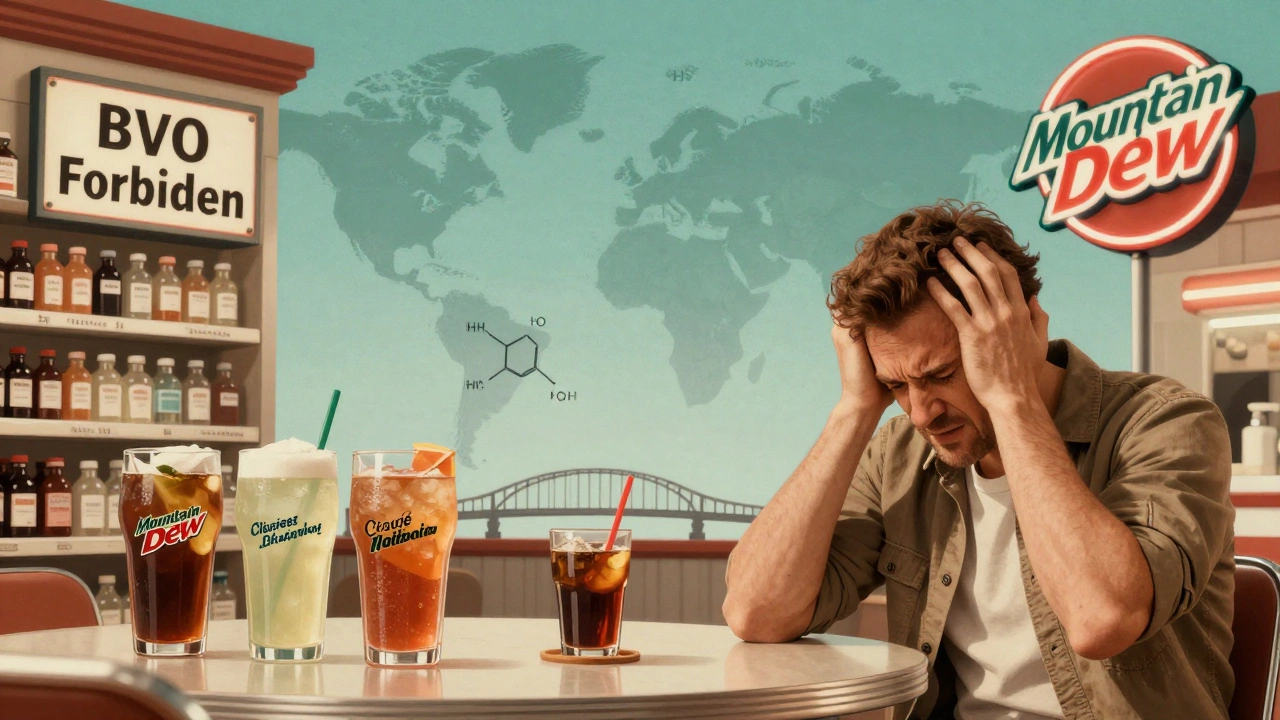
Mountain Dew isn’t sold in Europe because the company decided it wasn’t worth the cost to reformulate the drink just for a small market. PepsiCo already makes other citrus-flavored sodas there-like Pepsi Max or 7UP-that don’t contain BVO. Why spend money changing the formula for a drink that doesn’t have strong sales in the region?
Some European consumers have tried importing Mountain Dew from the U.S. or online retailers. But customs officials sometimes seize these shipments because BVO is classified as an unapproved food additive under EU Regulation (EC) No 1333/2008. Even if you bring it in for personal use, you’re technically breaking the law.
There’s also a version called “Mountain Dew Kickstart” that’s sold in Europe-but it doesn’t contain BVO. It’s marketed as a “fruit juice drink with caffeine,” not a soda, which lets it bypass the stricter rules for carbonated beverages.
What Other Countries Have Banned BVO?
BVO is banned in more than 100 countries. Besides the EU and Canada, it’s prohibited in:
- Japan
- India
- United Kingdom
- Australia
- New Zealand
- Singapore
- China
In Australia, where I live, BVO has been banned since the 1980s. Even if you tried to import Mountain Dew from the U.S., the Therapeutic Goods Administration (TGA) would flag it. That’s why you’ll never see it on shelves here-even in American-themed convenience stores.
What’s Replacing BVO Now?
Most major soda brands have moved away from BVO. Coca-Cola replaced it in Sprite and Fanta in 2020. PepsiCo switched Mountain Dew’s formula in the U.S. in 2014. The new ingredient, SAIB, is derived from sugar and fatty acids. It’s naturally occurring in some fruits and is considered safe by global health agencies.
Some smaller brands still use BVO in specialty drinks, especially in Latin America and parts of Asia. But the trend is clear: consumers are demanding cleaner labels. Companies that cling to outdated additives risk losing trust-and sales.
Is Mountain Dew Still Dangerous?
If you’re drinking the current U.S. version of Mountain Dew, you’re not at risk from BVO. The real health concerns now are sugar content and caffeine. One 12-ounce can has 46 grams of sugar-nearly 12 teaspoons-and 54 milligrams of caffeine. That’s less than a cup of coffee, but still a lot if you’re drinking multiple cans a day.
Compared to other energy drinks, Mountain Dew isn’t the worst. It doesn’t have taurine, guarana, or high-dose B-vitamins like Red Bull or Monster. But it’s still a sugary soda with artificial coloring and preservatives. For athletes or active people, it’s not a smart hydration choice. Water, electrolyte drinks, or even black coffee are better options.
What Should You Do?
If you’re in Europe or another country where BVO is banned, don’t worry-you’re already protected. You won’t find Mountain Dew on store shelves, and that’s by design. If you’re in the U.S. and you’re concerned about ingredients, check the label. If it says “BVO” or “brominated vegetable oil,” you’ve got an older version. Return it. If it says “SAIB” or nothing at all, you’re fine.
For anyone trying to cut down on processed drinks, the lesson isn’t just about BVO. It’s about asking: Why do we need synthetic chemicals to keep citrus flavor from floating to the top? Why not just use natural emulsifiers like gum arabic or pectin? The food industry is slowly moving that way-but consumer demand drives the change.
Mountain Dew’s absence in Europe isn’t a mystery. It’s a sign that regulations can protect public health-even if it takes decades. And while the drink itself isn’t lethal, the fact that it took so long to remove a risky ingredient tells you something about how slow food safety systems can be.
So if you’re wondering why you can’t find Mountain Dew in Europe, the answer is simple: they chose safety over nostalgia. And maybe, just maybe, the rest of the world will catch up.
Is Mountain Dew banned in the UK?
Mountain Dew is not officially banned in the UK-it’s simply not sold there. The reason is that it historically contained brominated vegetable oil (BVO), which is prohibited under UK food safety laws. Even though PepsiCo removed BVO from U.S. versions in 2014, the company has never reformulated the drink specifically for the UK market. You won’t find it in supermarkets or convenience stores.
Can you buy Mountain Dew in Europe online?
You can buy Mountain Dew online from U.S. retailers and have it shipped to Europe, but customs officials may seize the package. The EU bans brominated vegetable oil (BVO) as a food additive, and if your bottle contains it-which older or non-U.S. versions often do-it’s considered illegal. Even if you’re buying it for personal use, importing it violates EU Regulation (EC) No 1333/2008.
Does Mountain Dew still contain BVO in the U.S.?
No, Mountain Dew sold in the U.S. no longer contains BVO. PepsiCo removed it in 2014 and replaced it with sucrose acetate isobutyrate (SAIB), a safer alternative approved by the FDA. If your bottle lists BVO on the ingredients, it’s either an old stock, imported from another country, or a counterfeit product.
Is BVO dangerous in small amounts?
The FDA considers BVO safe at levels below 15 parts per million, but long-term exposure-even at low levels-can lead to bromine buildup in the body. Studies have linked high bromine intake to thyroid disruption, neurological issues, and skin rashes. While occasional consumption isn’t likely to cause harm, regular drinkers-especially teenagers-could be at risk. That’s why health agencies in the EU, Canada, and Japan banned it outright.
What are safer alternatives to Mountain Dew?
For a citrus-flavored energy drink without BVO or excessive sugar, try options like: Sparkling Ice (zero sugar, natural flavors), Hint Kick (sugar-free, with natural caffeine), or even black coffee with a splash of lemon. For athletes, electrolyte drinks like Nuun or Liquid I.V. provide hydration without artificial additives. Always check labels for hidden sugars and unapproved ingredients.

Comments (11)
Reshma Jose
12 Dec 2025
I remember trying Mountain Dew in college and thinking it tasted like liquid neon. Then I found out it had this weird chemical called BVO and was like... wait, why is this even in food? I switched to sparkling water with lemon and never looked back. My skin cleared up too, weirdly enough.
rahul shrimali
13 Dec 2025
BVO is just another corporate lie we swallow with our soda
Eka Prabha
14 Dec 2025
Let us not overlook the systemic failure here. The FDA’s interim classification of BVO represents a grotesque regulatory capture wherein industry lobbying supersedes longitudinal toxicological review. The 15 ppm threshold, established in the pre-epidemiological era, is not merely outdated-it is a public health liability. The fact that PepsiCo replaced BVO in the U.S. but not globally speaks to a deliberate stratification of safety standards based on market economics. This is not negligence. It is structural harm.
Bharat Patel
15 Dec 2025
You know, it’s funny how we accept things as normal until someone points out they’re kind of wild. Like, why do we need oil glued with bromine to keep citrus flavor from floating? We used to make things with simple stuff-sugar, water, real fruit. Now we engineer solutions to problems we created in the first place. Maybe we’re just too lazy to go back to basics.
Bhagyashri Zokarkar
15 Dec 2025
ok so i was drinking mountain dew every day for like 3 years and i started having these weird tingling hands and like brain fog and i thought it was stress but then i read this and i was like oh no no no and i stopped and it got better like 2 weeks later but now im paranoid about everything i eat like even my cereal has like 5 chemicals i cant pronounce and i cry every time i go to the grocery store
Rakesh Dorwal
15 Dec 2025
Europe banned it because they’re weak. Americans don’t need coddling. If you can’t handle a little bromine, maybe you shouldn’t be drinking soda at all. This is just another way the EU tries to control us with their socialist food police. We’ve been drinking this since the 80s and we’re still standing.
Vishal Gaur
17 Dec 2025
so i just checked my last bottle of mountain dew and it says saib now but i still feel weird about it like why do we even need any of this stuff why not just use real lemon juice and sugar like how it was back in the day i mean who even thought of bonding oil with bromine like what kind of lab is this
Nikhil Gavhane
17 Dec 2025
It’s actually kind of hopeful that companies like PepsiCo listened and changed their formula. It shows that when enough people care, things can improve-even if it took decades. The fact that BVO is banned in over 100 countries means we’re slowly moving toward a world where safety matters more than profit margins. Small wins still count.
Rajat Patil
19 Dec 2025
Thank you for sharing this information with such clarity. It is important that we understand the reasons behind food regulations, not merely accept them. The decision to remove BVO reflects a growing awareness of long-term health impacts. May we continue to prioritize well-being over convenience in all aspects of consumption.
deepak srinivasa
20 Dec 2025
Wait, so if SAIB is safe, why didn’t they just use it everywhere from the start? And why does Mountain Dew Kickstart get to bypass the rules by calling itself a ‘fruit juice drink’? Is this just a loophole? What else are they hiding behind labeling tricks?
pk Pk
21 Dec 2025
Hey everyone, if you’re worried about what’s in your drinks, start reading labels. It’s not about being paranoid-it’s about being informed. And if you want something tasty without the junk, try making your own lemonade with sparkling water and a splash of honey. It’s cheaper, healthier, and you know exactly what’s in it. Small changes add up.